
When “I” Becomes “We”: Understanding The Self as a System and Identifying as Plural

A therapist may occasionally hear something that challenges one of our most deeply ingrained assumptions about the self: “I don't experience myself as just one person.”
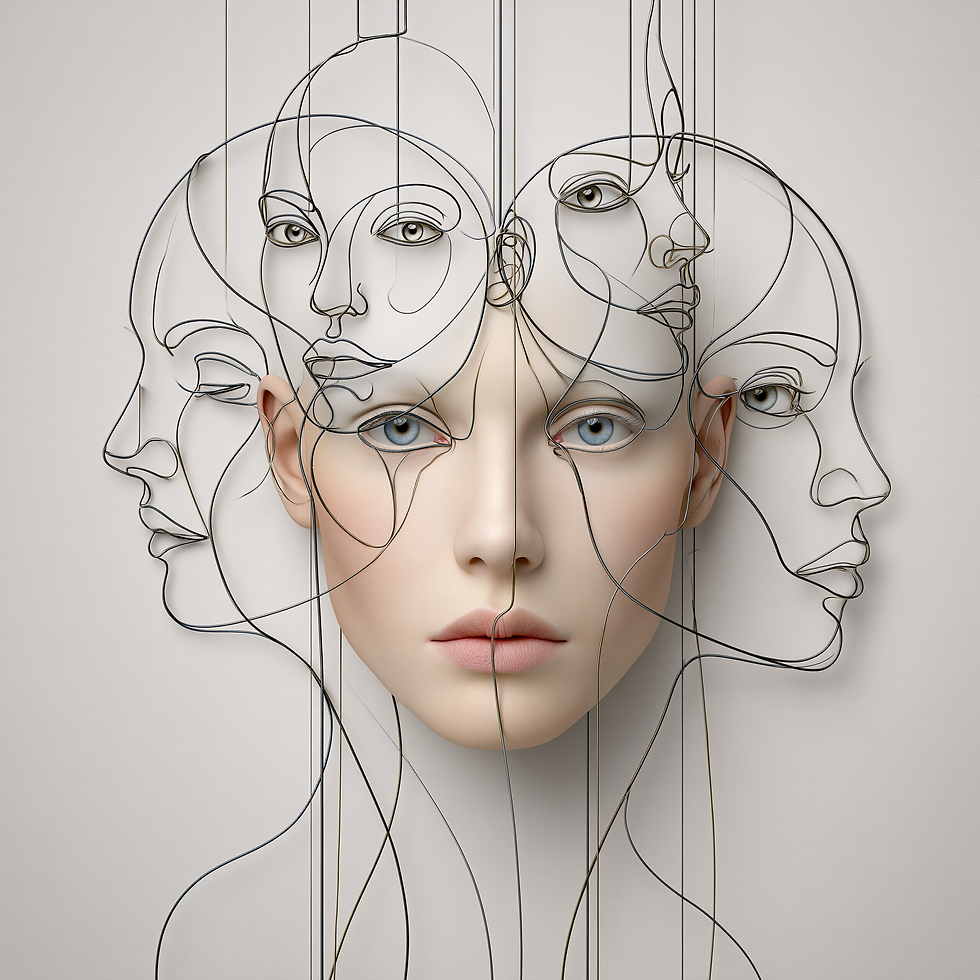
Increasingly, an increasing number of clients describe themselves as plural, multiple, or as a system. They may use language such as “we” rather than “I,” and may describe several distinct selves, sisters, or “headmates,” sharing one body and participating in a shared life.
For clinicians accustomed to thinking of identity as singular, this can initially sound like a description of psychopathology. It is worth slowing down before making that assumption.
Plurality is not, in itself, a psychiatric diagnosis. Rather, it is a way some people conceptualize and describe their experience of selfhood. There is considerable variation in what that experience looks like. Some people describe distinct identities with different personalities, preferences, ages, or perspectives. Others experience their selves as less clearly differentiated. Some describe strong internal relationships and communication between selves, while others experience their plurality in ways that are difficult to categorize.
Importantly, identifying as plural does not automatically mean that someone is distressed or unable to function. Some people who identify this way work, maintain relationships, pursue education, raise families, and participate fully in their communities. Their understanding of themselves as a “system” may simply be the framework that makes the most sense of their internal experience.
This is one of the areas where clinicians benefit from separating difference from disorder.
Plurality Is Not Synonymous With Dissociative Identity Disorder
It is understandable that therapists may initially associate plurality with dissociative identity disorder (DID), given the overlap in some of the language used to describe these experiences. But the concepts are not interchangeable.
DID is a clinical disorder characterized by a disruption in identity involving two or more distinct personality states, accompanied by discontinuities in memory and other symptoms, with the condition causing clinically significant distress or impairment.
Plurality, by contrast, is not defined by the presence of a disorder. Research examining people who identify as multiple or plural has found considerable variation in memory, identity, internal organization, and functioning. In particular, the absence of significant distress or functional impairment, and the absence of the characteristic amnesia associated with DID in many cases can distinguish some plural experiences from DID.
A client describing themselves as plural does not, by that fact alone, indicate a need for hospitalization or crisis intervention. As with any client, the appropriate level of care should be determined by their actual symptoms, safety, distress, and functional needs, not simply by an unconventional form of identity.
This does not mean that every person who identifies as plural is free from psychological difficulties, nor does it mean that someone with DID cannot function well in many areas of life. Clinical assessment should remain individualized. The point is simply that plurality itself should not be treated as evidence of psychopathology.

A Concept of the Self Rather Than a Symptom
Perhaps the most useful way for therapists to approach plurality is with curiosity rather than alarm. Psychology has long recognized that the self is more complicated than a single, perfectly consistent voice. We behave differently in different relationships and contexts. We hold conflicting values, emotional states, roles, memories, and perspectives. Most of us experience some degree of internal multiplicity, even if we understand all of those experiences as belonging to one person.
For someone who identifies as plural, the conceptual boundary may be drawn differently. Rather than understanding their experience as one self with many parts, they may understand themselves as multiple selves sharing one life. That distinction can be profound without necessarily being pathological.
The clinician's task is not to determine which philosophical model of selfhood is objectively correct. It is to understand how the client experiences themselves, what meaning that framework holds for them, and whether there are symptoms or difficulties that warrant clinical attention. In other words, the question is not simply, “How many selves are there?” It is, “How is this experience affecting this person's life?”
What We Know and What We Don't
It is important to acknowledge how early the research on non-clinical or non-pathological plurality remains. A 2023 systematic review identified only 13 relevant qualitative studies involving 98 participants, underscoring how limited the empirical literature is compared with the substantial attention given to dissociative disorders.
There is also significant heterogeneity within the population. “Plural” can encompass very different experiences, and researchers are still working to understand how these experiences relate to dissociation, identity, trauma, culture, and other psychological phenomena. That uncertainty should invite humility rather than dismissal. For clinicians, it means avoiding two equally unhelpful assumptions: that plurality must be a symptom of illness, or that it can never coexist with psychological distress. Both possibilities deserve consideration on an individual basis.
A More Curious Clinical Conversation
When a client says, “We are a system,” the most productive response may not be a diagnostic conclusion. It may simply be a question of what that means for the client, which opens space for understanding without immediately pathologizing the client's experience.
A therapist can explore how the system experiences itself, how communication works between selves, whether there are difficulties with memory or functioning, and whether the client's experience causes distress. These are clinically meaningful questions regardless of the language the client uses to describe themselves.
It also allows the therapist to recognize something fundamental: people do not always need their experience of selfhood to be reduced to a symptom in order for therapy to be useful.
For some plural clients, being understood may be therapeutic in itself.
As the research develops, psychologists will undoubtedly learn more about plurality, its relationship to dissociation, and the many ways human beings construct an understanding of who (or who all) they are.
For now, perhaps the most responsible position is one of curiosity. Not every unusual experience is a disorder. Sometimes, what appears unfamiliar to the clinician is simply another person's way of making sense of being human.
Comments